A Faraday bag and a shielded cell phone locker may look like two very different solutions, but appearance is not the most useful way to choose between them. Customers sometimes assume that a solid metal locker must automatically provide a level of shielding that a bag cannot match. At JEMIC, we can design our shielded bags and lockers to achieve the same required shielding level for the application. The more practical question is usually much simpler: Does your shielding need to move, or stay in one place?
That distinction changes the decision from a generic product comparison into an operational one. A company that needs devices shielded in a single controlled room has different requirements from an organization whose devices travel between locations. There are also practical considerations such as how the shielding products will be stored, who will have access to them, and whether individual bags are likely to remain where they are supposed to remain. Once those requirements are clear, the choice between a Faraday bag and shielded locker becomes considerably easier.
 Can a Faraday Bag Shield as Effectively as a Locker?
A shielded locker has one obvious physical advantage: the metal structure itself provides additional shielding. That does not mean a JEMIC Faraday bag is automatically a lower-performance solution. If an application requires additional shielding, we can add shielding material to the bag construction to raise its performance. As a result, both formats can be built to meet the required shielding level for the job.
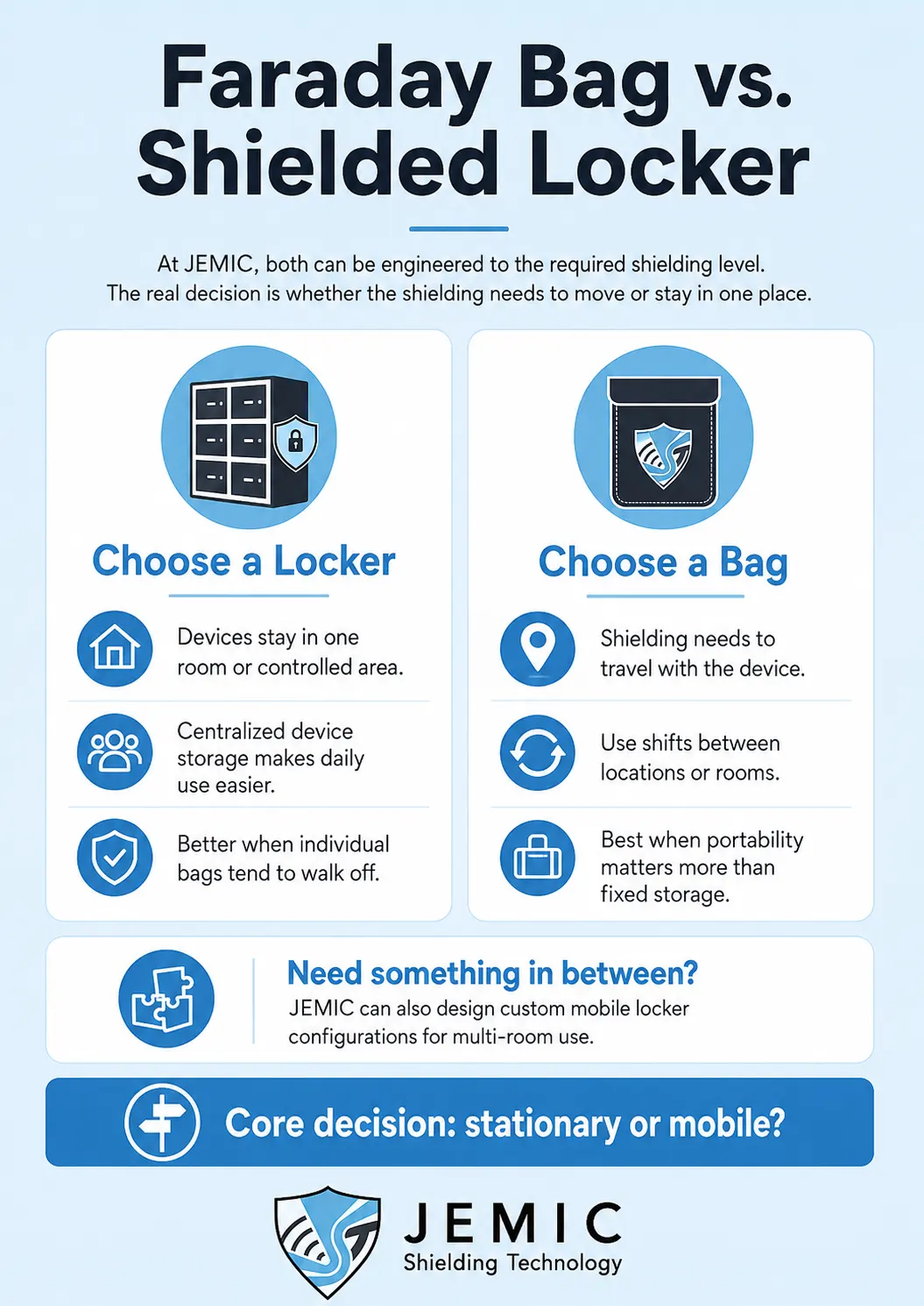
This is important because buyers should not choose a locker simply because it looks more substantial. The real requirement is the level of shielding the application needs and whether JEMIC can achieve that requirement in the chosen format. Once both formats can satisfy the performance target, physical use becomes the more meaningful differentiator. The question changes from “Which one blocks better?” to “Which one fits the way we actually need to control and shield these devices?”
| Application requirement | Better starting point | Why |
| Devices remain in one controlled area | Shielded locker | Creates a permanent, centralized shielding location |
| Devices must travel between areas or locations | Faraday bag | Shielding can move with the device |
| Several rooms need centralized shielding at different times | Custom configuration | JEMIC may be able to adapt the locker design to the workflow |
Choose a Shielded Locker When Devices Stay in One Location
If devices are repeatedly being collected and shielded in the same room or controlled area, a shielded cell phone locker is generally the more practical format. Instead of distributing an individual shielding product for every device, the organization has a fixed location where devices can be placed when they need to be isolated. The shielding stays where the process takes place, which can simplify the routine for environments where devices do not need to leave that area while shielded. In this type of application, portability may provide little practical value.
There is also a less technical reason some JEMIC customers have moved toward lockers: bags can disappear. We have supplied shielded bags to organizations, including government users, only to find that the bags tended to “walk off.” Once individual bags are distributed, they can be misplaced, removed from the area, or unavailable when someone needs them. A locker provides a shielding solution that is substantially harder to carry away and keeps the equipment tied to its intended location. For organizations managing many devices or many users, that operational consideration can matter just as much as the shielding specification.
This does not make a locker universally better than a bag. It means the locker solves a different logistical problem in addition to providing shielding. If the devices are brought to a single location for security and remain there until they are returned, a stationary system generally aligns well with that workflow. If the devices themselves need to remain shielded while being moved elsewhere, that same permanence becomes a limitation. The application, rather than the enclosure’s appearance, should determine the choice.
Choose a Faraday Bag When the Shielding Needs to Move
Faraday bags make more sense when shielding needs to follow the device. A phone or other device may need to be transported to another room, another facility, or another location while remaining inside the shielded enclosure. In that situation, installing a fixed locker does not solve the actual problem because the device leaves the locker as soon as it needs to move. The bag’s portability is the defining advantage.
This is also why we do not reduce the decision to a simple comparison of shielding strength. If JEMIC can build the bag to the shielding level required by the application, there is little benefit in choosing a stationary enclosure when the workflow requires mobility. Conversely, using portable bags for devices that never leave a single controlled area may add a management problem without providing a meaningful operational benefit. Matching the format to the workflow helps avoid paying for the wrong type of convenience.
The basic decision can therefore be reduced to a few practical questions:
- Will the device remain in one room or controlled area while it is shielded? Start with a locker.
- Does the device need to remain shielded while moving between locations? Start with a Faraday bag.
Does your workflow fall somewhere between those two situations? Discuss the actual movement and storage requirements with JEMIC before assuming either standard format is the answer.
What If the Locker Itself Needs to Move?
Some applications do not fit neatly into the stationary-versus-portable distinction. JEMIC is currently developing a custom locker configuration for a customer who needs shielded storage in several rooms but does not need those rooms serviced at the same time. Buying and installing a separate locker in every room would not match how the customer actually intends to use the equipment. Their solution is a wheeled locker so the same shielded storage system can be moved from room to room as needed.
Choose Based on How the Shielding Will Actually Be Used
The choice between a JEMIC Faraday bag and shielded cell phone locker does not have to begin with assumptions about which product is more powerful. We can engineer both formats around the shielding requirement, so the more useful starting point is the customer’s workflow. If devices remain in a single controlled location, a locker usually provides a cleaner, more manageable solution; if the shielding must travel with the device, a Faraday bag generally makes more sense. If your application combines mobility, centralized storage, or another unusual requirement, contact JEMIC so we can evaluate the actual use case and determine whether a standard or custom configuration is the better fit.